
FROM OUR BLOG
January 2, 2026
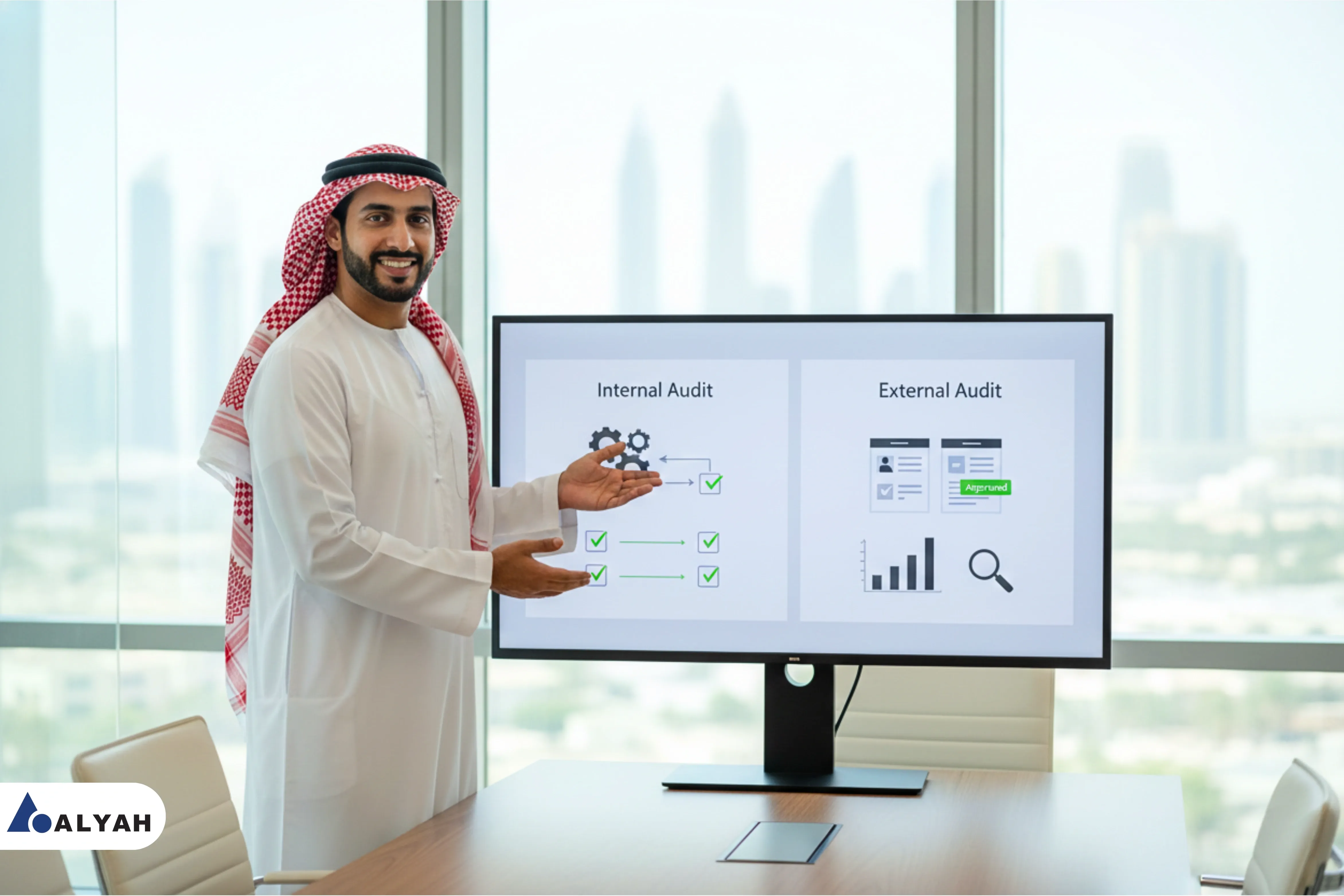

There are many audit types in the UAE, with internal and external audits being the most widely adopted. Though the two audits commonly involve the examination of the business entity and activities in a systematic way, there exist significant differences regarding the objective, scope, and even outcomes derived from their execution.
Understanding of these differences is crucial to informed decision-making.
An internal audit is an independent review within the organization or external internal audit services UAE, which mainly aims to assess the internal controls, efficiency, risk management, and governance structure.
Internal audits assist organizations in:
In addition, companies looking forward to proactive risk mitigation measures, risk management audit Dubai through internal audits provides useful information before a problem arises.
An external audit is carried out by an independent audit firm that is licensed, and it aims at ensuring that the financial statements made by the business are true and fair. External audit requirements UAE are commonly mandatory for:
These are mainly compliance-oriented and are presented to the regulators and to third-party bodies as well.

Understanding the difference between internal and external audit helps explain their roles.
Purpose: Internal audits help in the improvement of processes and controls, while external audits validate financial statements.
Legal requirement: The internal audits are usually not compulsory, but the external audits are often legally necessary.
Frequency: Internal audits may be continuous; those from outside are generally annual.
Reporting: Internal audit reports go to the management while external audit reports go to the regulators and stakeholders.
Both audits complement each other and are not in competition.
Deciding between internal audit vs external audit UAE often Wes based on your requirements:
Startups & SME’s: Outsourced audit work for regulatory compliances; internal audit processes subsequent to the expansion of the business.
Growing companies: Combination of internal audits and external audits to ensure adherence to regulations and government guidelines.
Regulated Entities: Both audits are highly recommended in order to fulfill governance requirements.
Relying solely on audits is legal compliance but can be risky in operations.
Internal audit vs external audit UAE differences involve understanding the nature of the two processes. It’s not a case of one being better than the other but rather understanding the difference between them. For instance, one may choose an internal audit over an external audit based on the nature of
Having a sound approach to auditing enables UAE companies to remain compliant, proactively manage risks, and earn the trust of regulators, investors, and partners for ensuring its sustained growth in the highly competitive market.
The main difference between internal and external audits is their objective. Internal audits aim at making improvements in internal controls, risk management, and efficiency, while external audits aim at ensuring that financial reports are indeed accurate.
Internal auditing is not generally compulsory for most businesses. But many businesses choose internal audit services UAE for the purposes of improvement in governance, early identification of risks, and compliance with the law especially for businesses that expand.
External audit requirements in the UAE Most companies operating on the mainland as well as free zones are required to undergo external audit requirements UAE. External audit requirements are normally carried out when trade license renewals, as well as financial reporting to investors, are required or when finance is sought from the banks and free zone bodies like DMCC and DIFC.
Even though an external audit can fulfil regulatory mandates, this type of audit is not capable of identifying risks or weaknesses in internal processes. Companies that conduct external audits annually could overlook important warning signals that an internal audit is intended to point out.
Internal audit services UAE provide assistance to organizations in conducting internal control assessments, analysing risk exposure, optimizing efficiency, as well as adhering to policies. These services would be of help to a business concerned about risk management.
A risk management audit Dubai is all about risk identification, risk assessment, and effective risk mitigation within an organization. A risk management audit is often carried out as a part of an internal audit exercise.
The external audit usually takes place once every year as per the requirements of the regulating authority. Internal audits can be carried out on an annual basis, or on an quarterly as well as continuous basis, depending upon the company’s magnitude and risk level.
Yes. Internal and external audits can complement each other. When a company has strong internal controls as identified by its internal audits, it can function well during an external audit with fewer findings from regulators.



ALYAH
Unit Number: 2401
Preatoni Tower, Cluster L, JLT, Dubai

+971 42873327

sales@alyahaudit.ae
Click to open in Google Maps