
FROM OUR BLOG
November 12, 2025
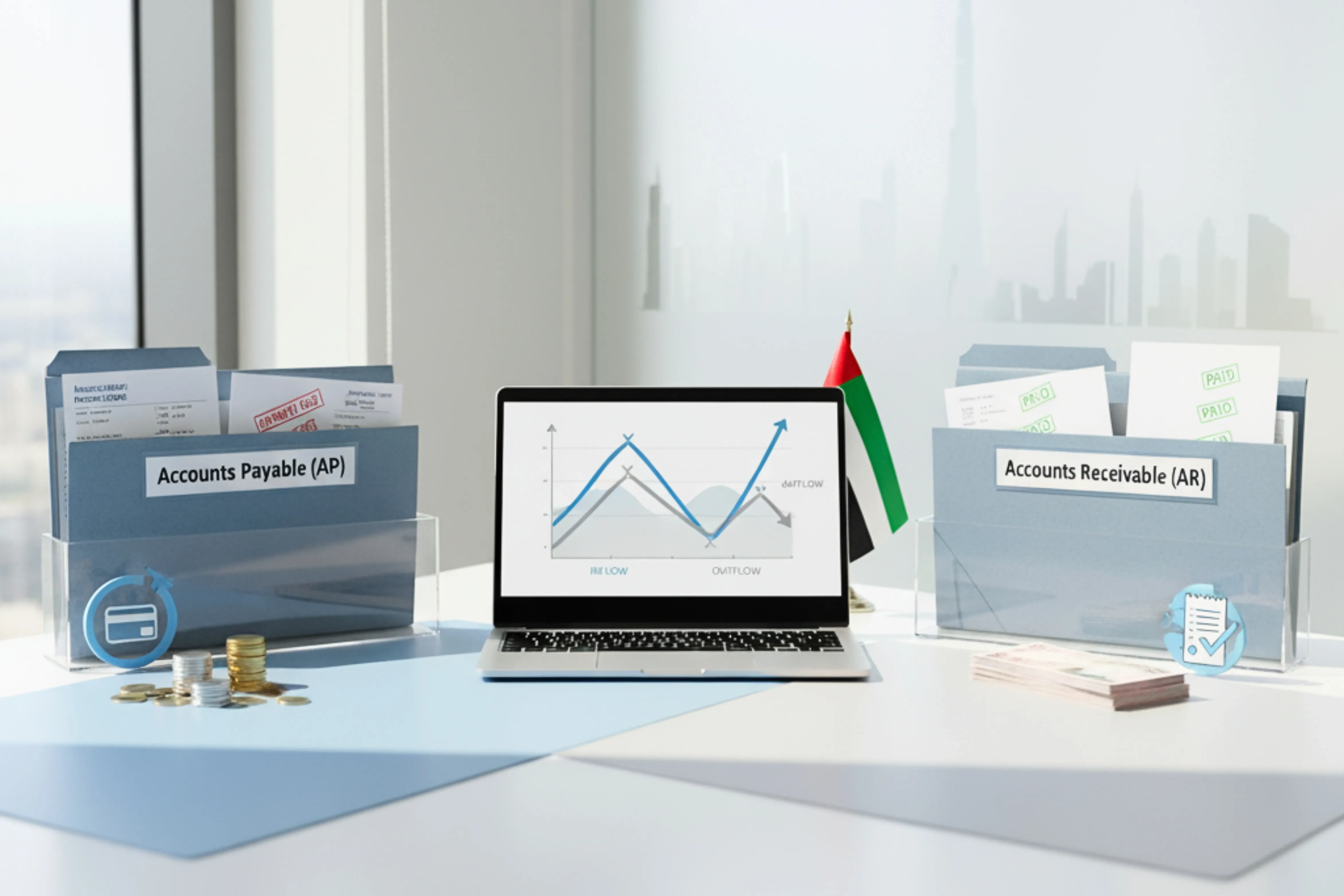

Accounts Payable (AP) refers to the money your company owes to suppliers or vendors. It’s recorded as a liability on your balance sheet because it represents future payments.
For example:
If your Dubai-based import business buys office furniture or raw materials on credit, the unpaid invoice sits in your accounts payable.
In simple terms, Accounts Payable (AP) is the money you owe, and managing it wisely helps you keep vendors happy without draining your cash. Working with professionals who specialize in financial reconciliation can ensure your payables are always accurate and up to date.
Accounts Receivable (AR) refers to the money your customers owe you for products or services already delivered. It’s an asset because it represents incoming cash.
For instance, if your consulting firm in Dubai provides a business compliance service to a client and invoices them for AED 10,000, that amount is your accounts receivable.
In short, Accounts Receivable (AR) is the money owed to you, and managing it well ensures smooth cash inflows. Partnering with experts who offer management reporting can help you track these inflows accurately and make informed financial decisions.

Running a business in the UAE means operating in a highly compliant, fast-moving environment with VAT laws, supplier regulations, and local invoicing rules to follow.
For Russian entrepreneurs, this can feel complex, especially when managing cross-border transactions or dual-currency accounts (AED and RUB/USD).
Regulatory compliance: Properly tracking payables and receivables aligns with UAE’s accounting standards and VAT filing requirements.
Cash flow stability: Balanced AP/AR ensures your business maintains liquidity, even during slow seasons.
Vendor & client trust: Timely payments and collections strengthen relationships and reputation.
When your AP is too high, you may risk supplier penalties. When your AR is delayed, you might struggle to pay employees or renew business licenses. Balance is key.
Follow these proven steps to keep your finances balanced and compliant:
Use UAE-friendly accounting tools like Zoho Books, TallyPrime, or QuickBooks to manage invoices in multiple currencies.
Regular reconciliation of AP & AR ensures accuracy in VAT reporting and prevents errors during audits.
Track expected inflows and outflows weekly to prevent shortages.
For Russian entrepreneurs unfamiliar with UAE’s accounting regulations, partnering with a local compliance firm can ensure error-free financial reporting.
Many expat-run businesses in the UAE make the same financial mistakes repeatedly. Avoid these to stay compliant and cash-flow positive:
Expert Tips for UAE Business Owners
Tip 1: Always align your AP/AR strategy with your VAT cycles (usually quarterly).
Tip 2: Use automated reminders to collect client payments faster.
Tip 3: Conduct quarterly cash flow audits to identify payment delays.
Tip 4: Maintain a cash reserve equivalent to 2–3 months of expenses.
These small adjustments can significantly improve liquidity and financial predictability.
In UAE’s competitive and compliance-driven business environment, understanding Accounts Payable vs Accounts Receivable is essential for long-term stability.
For Russian entrepreneurs, maintaining a balance between what you owe and what you’re owed ensures liquidity, reduces stress, and supports smooth operations.
Pro tip: Partner with Alyah Audit a trusted accounting and compliance firm in the UAE to automate your AP/AR processes, improve reporting accuracy, and maintain a strong financial foundation for your business.
Accounts payable is the money you owe suppliers, while accounts receivable is the money customers owe you.
AP affects your outflow (money leaving), and AR affects your inflow (money coming in). Efficient management of both keeps your business cash flow balanced.
In UAE, these processes involve creating invoices, recording VAT, reconciling ledgers, and ensuring compliance with local accounting standards.
Yes. Many Russian entrepreneurs in the UAE outsource AP/AR services to local accounting firms for accuracy and compliance efficiency.
Delayed AR causes cash shortages, late supplier payments, and potential compliance penalties.
Not necessarily it depends on business size and structure. Accounts payable (AP) can be complex due to multiple vendor payments and deadlines, while accounts receivable (AR) requires consistent follow-up to ensure timely collections. Both demand strong systems and financial discipline.
Neither is “better”; both are essential. AR ensures cash inflow, while AP manages outflow efficiently. The key lies in balancing both collecting receivables quickly while paying suppliers strategically to maintain healthy cash flow.
A healthy AR to AP ratio typically falls between 1.2 to 2.0, indicating that receivables are higher than payables. This means a business can cover its short-term obligations comfortably without liquidity stress.
A good Accounts Receivable Turnover in Days (DSO) ranges from 30 to 45 days in most industries. Lower numbers mean faster cash collection, which improves working capital and reduces dependency on external financing.
Separating AP and AR ensures better internal control, minimizes errors, and prevents fraud. It also allows teams to specialize AP focuses on vendor management, while AR emphasizes customer collections and revenue tracking.



ALYAH
Unit Number: 2401
Preatoni Tower, Cluster L, JLT, Dubai

+971 42873327

sales@alyahaudit.ae
Click to open in Google Maps